While I try my best to interest Tractor Supply in the biggest improvement that has ever happened to Horse Keeping, this showed up in my LinkedIn feed:
Let me apply this to “SlowFeeding 2.0 Feeding-Freedom”:
Opportunity: The chance to own the biggest evolutionary leap in the history of international horse keeping.
Good judgment: 60% of all domesticated horses suffer from stomach ulcers (EGUS), SlowFeeding 2.0 is the natural solution. Today, all domesticated horses are being fed 2-3 times a day, which is an enormous waste of time for the caregiver since SlowFeeding 2.0 makes one feeding a day (or one every other day) better for the horse, and reduces the time feeding takes and removes the fixed feeding schedule.
Intelligent risk: SlowFeeding 2.0 is a unique and structural improvement to an international standard. Evaluating the products and selling them through your own channels would minimize the risk.
Drive speed to market: The international horse world is waiting for TSC’s decision.
Champion ideas: Slow Feeding 2.0 creates free time for modern horse owners, cures EGUS, and makes SlowFeeding available also for horses in boarding stables that earlier refused SlowFeeding because of the time-consuming work of filling hay nets, even though the horse owners asked for it. Can it be better?
Let us discuss the details.
Best Regards
Good Lind
good@slowfeedingnets.com
*****************************************************************************
If the above text made you even a little interested, you might consider reading on.
I know feeding horses hay is not a ”sexy” business and it’s certainly not high tech, but it’s the most important part of horse keeping, and it affects every domesticated horse in the World.
From the beginning of time until 2008, hay feeding didn’t evolve at all; hay was just dumped in front of the horse’s feet twice per day.
Over half a century ago, scientists discovered that most horses were suffering from gastric ulcers, and they suspected it was because if the horse doesn’t eat for something like 16 hours a day, the continuous production of stomach acid will overfill the stomach with acid that will burn the upper, unprotected, part of the stomach wall, creating ulcers.
The unsolvable problem was that if domesticated horses get free access to hay, they eat too much and get fat.
All this has been known for a very long time, but no one found a good solution for how to make the horse eat slower, for longer, and less, until the year 2008, when I launched the Slow Feeding concept. SlowFeeding 1.0 was in the shape of hanging small mesh hay nets, and they are effective in reducing waste and extending the eating time, which is good.
Hanging hay nets does, however, come with two serious drawbacks:
– Filling hay nets is a tedious waste of time, which stopped it from being used in commercial stables even though the horse owners asked for it,
– Hanging nets forces the horse to eat from a vertical surface, which creates awkward eating angles and stops him from relaxing.
Even so, Slow Feeding revolutionized the international hay feeding market, and today it looks like a hay feeder must be called a Slow Feeder to sell, whether it has anything to do with the Slow Feeding concept or not.
SlowFeeding 2.0 Feeding-Freedom:
- Keeps the good parts of the loved international standard SlowFeeding 1.0, and removes the flaws.
- Let the horse eat straight forward and from the top down, standing completely relaxed in balance.
- Removes the risk of sand colic, which comes with eating loose hay from the ground.
- Removes the health risks associated with eating and breathing close to contaminated bedding.
- Makes horse eat naturally and not fill his mouth with loose hay, which he doesn’t chew enough.
- Are premium products priced to make them worth selling, not cheap hay nets that don’t even pay for the shelf space they occupy?
- Are image-builders for those who make them, sell them, and use them. They signal knowledge and responsibility.
- Will make TSC the undisputed market leader of what every domesticated horse in the world relies on, hay feeding.
- Will completely transform the work of feeding horses hay from being a chore that always collides with social activities to being something you do when being with your horse for joy and pleasure.
SlowFeeding 2.0 Feeding-Freedom makes the impossible possible.
If you have 3 horses in a paddock, feeding them hay can take 7.5 seconds per horse, per day,
And they would still have continuous access to the hay without eating too fast or too much.
Feeding the horse takes 7.5 seconds/day
45 seconds* / 3 horses / 2 days = 7.5 seconds / horse / day
and the next feeding can be done any time during the 48 hours
and they will still have continuous access to the hay without eating too fast or too much,
if they have a SlowFeeding 2.0 Feeding-Freedom Paddock Box.
* 45 seconds is what it takes to fill the box when the wheelbarrow with the hay stands next to it.
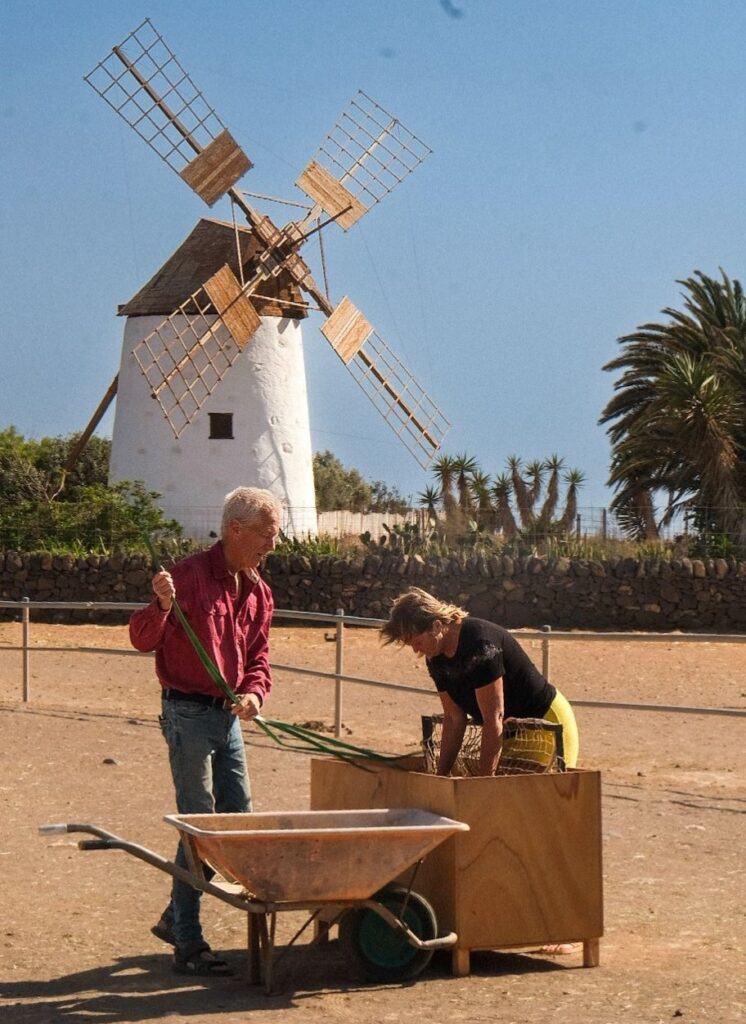
The picture shows a prototype of the Feeding-Freedom Paddock Box right after receiving a full three-string bale. The production model will be made of rotation-molded polymer and designed to ship in a flat package (IKEA-style).
You will be able to buy this and other SlowFeeding 2.0 Feeding-Freedom products like everyone else, or join me in a JV project and be the owner of the biggest jump in the evolution of horsekeeping, ever.
Thank you for your time.
I’m Good